




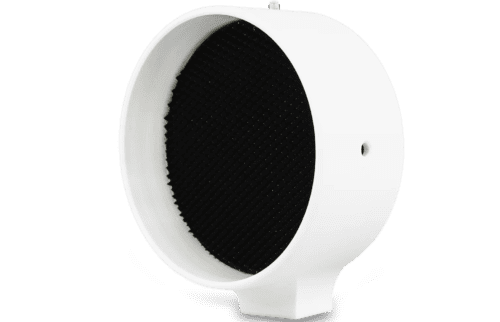







Germanium Lenses for Thermal Cameras & Thermal Cores
23. 6. 2026Thermal imaging technology
What Makes an Uncooled Thermal Core Truly Useful in the Field?
A thermal core is often judged by resolution first. In real applications, however, the image that matters is created by much more than the detector alone.
Workswell WEOM brings together an uncooled LWIR microbolometer, FPGA image processing, flexible interfaces, lens options and a compact mechanical design for professional OEM integration.
Resolution Is Only the Beginning
In thermal imaging, it is easy to start with detector resolution. It is a visible number and it helps describe how much information the sensor can capture. But in a professional thermal system, resolution is only one part of the story. The final image also depends on sensitivity, optics, calibration, processing and how well the core can be integrated into the final device.
Workswell WEOM is based on an uncooled LWIR microbolometer detector with 640 × 480 px resolution and a 17 μm pixel size. According to the datasheet, this 17 μm detector can provide up to 30% higher sensitivity than a 12 μm detector. That is important because a thermal image is not simply a picture. It is a visualization of temperature differences.
When the temperature contrast in a scene is high, many thermal cameras can produce a usable image. The real test comes when the scene is more demanding: similar background temperatures, changing outdoor conditions, movement, distance or integration into a compact mobile platform. In those situations, sensitivity and stability become just as important as resolution.
Why WEOM Is Designed as an Integration Core
WEOM is described by Workswell as an ITAR-free thermal imaging camera module designed and produced in Europe. It is intended for demanding applications such as unmanned vehicles, thermal monoculars and binoculars, fixed industrial and security cameras, maritime thermal cameras, machine vision, monitoring systems, intelligent systems, driving systems, defense and security.
This range of applications shows why a thermal core must be more than a detector board. In an unmanned vehicle, weight and power consumption matter. In a fixed security camera, long-term stability and control options matter. In machine vision or monitoring, interfaces and data output become critical. In all of these cases, the core must fit into a larger system.
Small Core, Large Role
The datasheet specifies compact dimensions for the CMOS version and weight below 65 g without the lens or plugin. This makes the module suitable for systems where space and mass are limited.
Fast Start
WEOM is specified with a time to start of less than 5 seconds, which is useful in systems where quick readiness is part of the operational requirement.
Image Quality Starts Inside the Core
The WEOM datasheet highlights advanced FPGA processing for image quality and scene visualization. This matters because raw thermal data is not yet the final image. The core must correct, process and present that data in a way that remains readable across different scenes.
WEOM includes integrated, factory-calibrated non-uniformity correction, temperature drift compensation, automatic image gain control, manual brightness and contrast control, spatial filtering, temporal moving average filters and multiple image palettes. These are not just software features. They help turn thermal measurement data into a stable visual output.
What Supports a Readable Thermal Image
- advanced FPGA processing for scene visualization,
- integrated factory-calibrated non-uniformity correction,
- temperature drift compensation,
- automatic and manual image gain control,
- spatial and temporal filters for improved image quality,
- multiple image palettes for different visualization needs.
Video demonstration
WEOM Thermal Imaging in Action
WEOM with 19 mm Lens
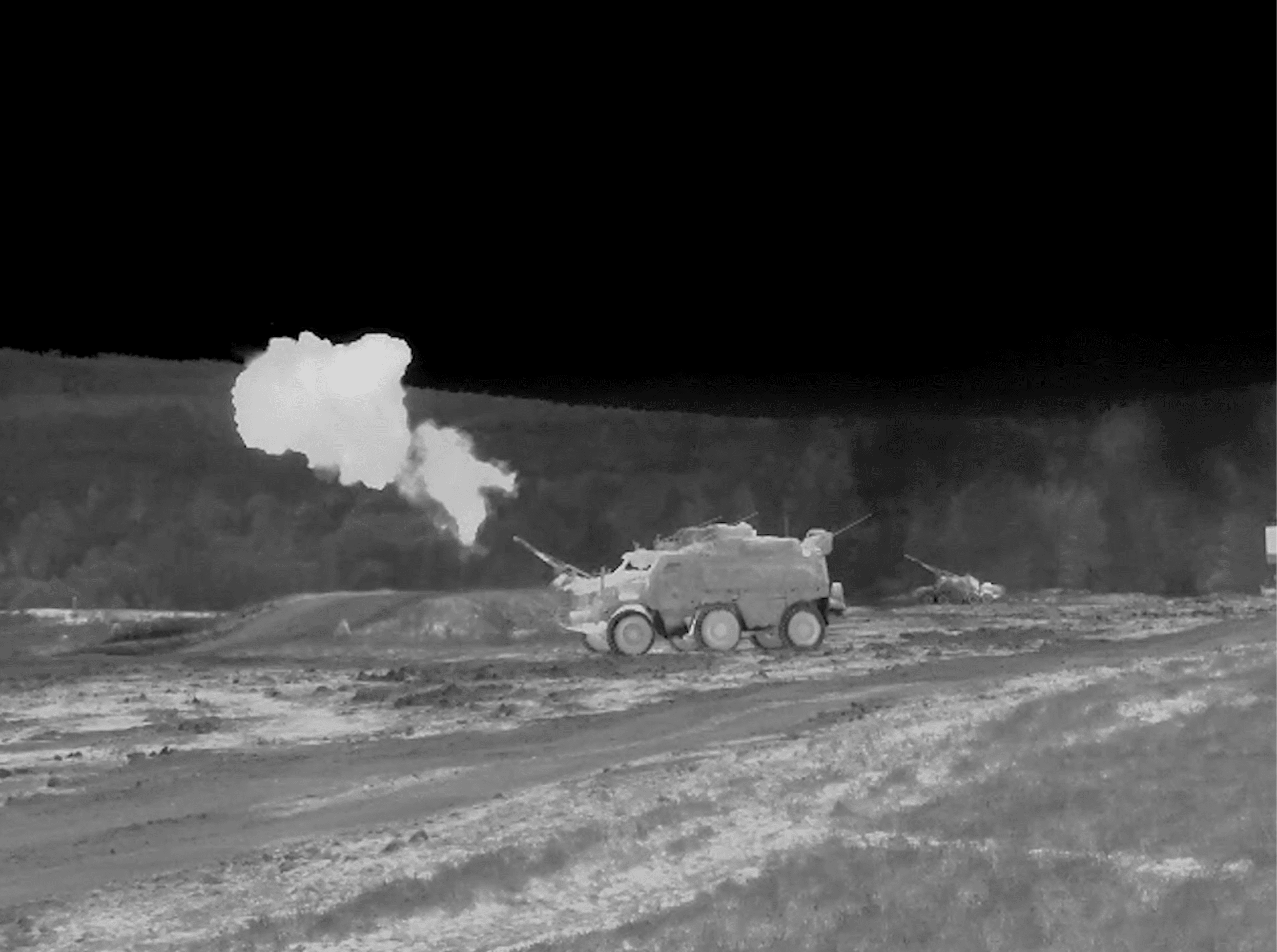
Example of 640 × 480 px thermal output with a 19 mm lens configuration.
WEOM with 35 mm Lens
Example of 640 × 480 px thermal output with a 35 mm lens configuration.
WEOM with 50 mm Lens
Example of 640 × 480 px thermal output with a 50 mm lens configuration.
The Lens Changes the Mission
The same thermal core can behave very differently depending on the selected lens. A wider field of view is useful when the system needs broad situational awareness. A longer focal length is useful when the application requires observation at greater distances. This is why WEOM offers a range of fixed-focus M25 and M34 lens options, as well as lens-less delivery with an M25 or M34 lens holder.
The datasheet lists M25 lenses with focal lengths of 14 mm, 25 mm and 35 mm, and M34 lenses from 7 mm up to 100 mm. This allows integrators to choose the optical configuration according to the intended field of view, target size, observation distance and mechanical design of the final system.
The datasheet also includes DRI information based on Johnson Criteria for detection, recognition and identification. Workswell notes that real values may vary depending on environmental conditions and integration.
Interfaces Are Part of Image Quality Too
In an OEM system, the image is useful only if it can be delivered, controlled and processed in the right way. WEOM provides exchangeable video and data plugins, including CVBS, Micro-HDMI, USB, GigE, Ethernet and CMOS options. This gives integrators flexibility when the core must be connected to different processing units, displays, embedded systems or network architectures.
Ethernet options include RTSP H.264 real-time streaming, a web server camera interface, ONVIF support for third-party software interoperability and network configuration such as static IP or DHCP. The datasheet also lists user-definable video output data streams via API, including pre-IGC MONO 14-bit data or post-IGC coloring data.
For Integrators
Exchangeable plugins help adapt the same thermal core concept to different electronic and system architectures.
For Real-Time Use
Video streaming, control options and API data output make the core suitable for systems that need more than a simple image feed.
Built for Demanding Environments
Professional thermal systems often operate outside laboratory conditions. They may be exposed to vibration, shock, temperature changes, humidity or demanding mechanical integration. The WEOM datasheet specifies an operating temperature range from −32 °C to +70 °C according to MIL standard, storage temperature from −50 °C to +90 °C, humidity from 5% to 95% non-condensing, vibration testing and shock testing.
The module uses a durable aluminum body and is specified as ROHS, REACH, WEEE and CE compliant. For integrators, these details matter because the quality of a thermal core is not only measured in image output, but also in how reliably the module can become part of the final product.
Conclusion: The Best Core Is the One That Fits the System
WEOM shows why thermal core quality should be understood as a complete system property. The detector provides the foundation, but the final value comes from the combination of sensitivity, FPGA processing, calibration, optics, interfaces, mechanical design and environmental robustness.
For professional applications, the goal is not only to generate a thermal image. The goal is to deliver a stable, readable and integrable thermal output that supports the mission of the final system, whether it is mobile, fixed, industrial, security, maritime or intelligent monitoring.
Note on Illustrative Materials
All illustrative footage, photos and videos used to present these capabilities come from training exercises and test scenarios. They do not show active combat. These materials were recorded at 640 × 480 px thermal resolution.
View Workswell WEOM Thermal CoreLooking for More?
If you are looking for a thermal imaging solution that combines European quality, top-tier performance, and complete regulatory independence, the WEOM Thermal Core is here to deliver. Completely ITAR-free and designed for seamless integration, this module isn’t just a component—it’s a comprehensive solution. Whether you need integration support or expert advice, our team is ready to help.
Interested in learning more or exploring integration possibilities?
Get in touch with our team—our experts are ready to help you find the perfect configuration to meet your mission requirements.
