











Navigation Challenges at Sea and the Power of Night Vision Technologies
30. 9. 2025
Why Germanium Lenses Matter in High-Performance LWIR Thermal Modules
20. 10. 2025Why Thermal Sensitivity Matters
Thermal cameras are often evaluated based on sensor resolution—much like regular digital cameras. However, the number of pixels isn’t the only factor that determines image quality. There's another crucial parameter that's just as important—if not more so—for real-world usability: thermal sensitivity, technically referred to as NETD (Noise Equivalent Temperature Difference).
Thermal sensitivity indicates the smallest temperature difference a camera can detect. It is measured in milliKelvins (mK), and the lower the value, the finer the details that can be captured. For example, a camera with sensitivity below 50 mK can reveal even subtle differences that are critical in practice—from early faults in electronic components to detecting a person in low thermal contrast environments. Conversely, a module with lower sensitivity will render such scenes with less contrast, reducing the informational value.
These differences become especially apparent in challenging conditions—such as fog, smoke, dust, or nighttime—where there is minimal temperature contrast between the object and its background. In such scenarios, higher sensitivity not only ensures better image quality but also extends detection range and enhances system reliability.

Cooled vs. Uncooled Sensors: Two Paths to High Quality
Traditionally, achieving high thermal sensitivity required cooled thermal cameras. These use cryogenic coolers to significantly reduce sensor noise, resulting in outstanding sensitivity and detailed imagery even in extreme conditions. However, this performance comes at a cost—cooled cameras are bulkier, require more maintenance, have limited lifespans due to moving parts, and are significantly more expensive.
On the other hand, advances in technology have enabled uncooled sensors to reach performance levels that were unthinkable just a few years ago. With NETD values below 50 mK, today’s uncooled modules are a viable alternative for a wide range of industrial and security applications. For integrators and manufacturers, it is therefore crucial to select the right module based on specific application requirements—whether the priority is maximum sensitivity, lifespan, compact size, cost, or a balanced combination of all these factors.
Workswell WEOM HD: A Modern Module for Demanding Applications
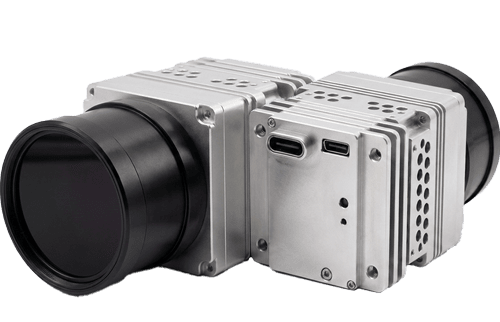
A prime example of how far uncooled technology has advanced is the Workswell WEOM HD Thermal Core. This module, developed and manufactured in Europe, is designed for integration into a broad range of systems—from UAVs and gimbals to fixed surveillance cameras, industrial inspections, and scientific projects.
The WEOM HD features an uncooled microbolometer with a resolution of 1280 × 1024 px and thermal sensitivity better than 50 mK, delivering detailed imagery even in low thermal contrast environments. Thanks to its compact size and lightweight design, it can be easily integrated into mobile platforms, while its wide range of communication interfaces (HDMI, USB-C, Ethernet with ONVIF support) allows for quick deployment into existing systems without complex development.
Additionally, the module incorporates advanced image processing on an FPGA, including spatial and temporal filtering, automatic contrast control, and more than ten color palettes. In practice, this means the WEOM HD delivers not only high sensitivity but also clear and readable images. With its combination of sensitivity, resolution, and robust design, the Workswell WEOM HD ranks among the most advanced uncooled LWIR modules on the market. It offers professional-grade performance—once reserved for expensive cooled systems—in a compact and reliable form factor suitable for a wide range of applications.
Looking for More?
If you are looking for a thermal imaging solution that combines European quality, top-tier performance, and complete regulatory independence, the WEOM HD Thermal Core is here to deliver. Completely ITAR-free and designed for seamless integration, this module isn’t just a component—it’s a comprehensive solution. Whether you need integration support or expert advice, our team is ready to help.
Interested in learning more or exploring integration possibilities?
Get in touch with our team—our experts are ready to help you find the perfect configuration to meet your mission requirements.
