










Match Focal Length and FOV to Your Mission
24. 2. 2026
Thermal Optics vs Sensor Resolution: Why MTF Matters in LWIR Imaging
24. 3. 2026High-Performance Germanium & LWIR Optics for Thermal Imaging
A Complete Guide to Thermal Imaging Lenses, Field of View, and Optical Performance
Germanium lenses and LWIR optics form the backbone of modern thermal imaging systems. Even the most advanced thermal sensor cannot deliver accurate, sharp, and reliable images without high-quality optics. In this guide, we explain why germanium is the key material for LWIR optics, how optical design influences thermal camera performance, and how to choose the right optics for thermal modules, UAV payloads, and industrial or security applications.
This page is designed as a central hub for LWIR optics and germanium lenses, with links to more detailed articles covering specific aspects such as coatings, field of view, and optical performance in thermal imaging systems.

What Is LWIR Optics? Germanium Lenses and Optical Design for Thermal Cameras
LWIR optics (8–14 μm) are the foundation of thermal imaging. Material choice, optical design, and coatings determine how much performance your thermal camera, core, or OEM module can actually deliver.
What Is LWIR Optics?
LWIR (Long-Wave Infrared) optics are designed for the 8–14 μm wavelength range, which is where most thermal cameras operate. Standard optical glass is opaque in this part of the spectrum, which means that special infrared materials must be used to transmit thermal radiation to the sensor.
Several materials can be used for LWIR optics, including germanium, zinc selenide, and silicon. Among these, germanium has become the industry standard for thermal cameras and thermal modules because it offers an excellent balance between infrared transmission, optical performance, and practical manufacturability. This is why most professional thermal imaging systems rely on germanium lenses as their primary optical element.
LWIR Optical Materials Comparison
| Material | LWIR suitability | Main advantages | Typical use |
|---|---|---|---|
| Germanium | Excellent (8–14 μm) | High refractive index, low dispersion, high IR transmission | Thermal cameras, cores, OEM modules, zoom optics |
| Zinc selenide | Good | Useful IR properties for specific designs | Specialized optical assemblies |
| Silicon | Limited for LWIR | Lower cost, limited LWIR performance | Niche or cost-sensitive designs |
Why Germanium Lenses Are Used in Thermal Camera Optics
Germanium lenses are widely used in LWIR thermal cameras because germanium efficiently transmits infrared radiation in the 8–14 μm range while providing a high refractive index and low optical dispersion. This combination allows optical designers to create compact lenses with high image quality and minimal aberrations, which is essential for modern high-performance thermal imaging systems.
Thanks to these properties, germanium optics are commonly found in thermal camera cores, OEM thermal modules, UAV and drone payloads, PTZ cameras, and industrial thermal cameras.
Higher refractive index enables more compact optics, while low dispersion helps control aberrations. The result is sharper images in smaller, lighter systems—critical for UAVs, PTZ cameras, and OEM modules.
How LWIR Optics Affect Thermal Camera Performance
In a thermal imaging system, the lens is just as important as the sensor itself. LWIR optics directly influence image sharpness, contrast, thermal sensitivity, and effective spatial resolution of the entire camera.
This becomes especially critical with high-resolution sensors, smaller pixel pitches, and long focal length or zoom lenses. Any optical imperfection is more visible at higher resolutions.
Germanium Lenses, Coatings, and Durability in Harsh Environments
Although germanium offers excellent optical properties for LWIR applications, the material itself is relatively brittle and sensitive to surface damage. For this reason, germanium lenses used in professional thermal cameras are almost always protected by hard surface coatings, most commonly Diamond-Like Carbon (DLC) and anti-reflective coatings optimized for the LWIR spectrum.
Why coatings matter
- DLC improves resistance to scratches and abrasion
- AR coatings increase transmission and reduce reflections
- Longer lifetime in UAV, maritime, and outdoor environments
Field of View, Focal Length, and Optical Design for Thermal Imaging
Focal length determines magnification and working distance, field of view defines how much of the scene is visible, and the aperture (F-number) influences both sensitivity and image quality.
Wide-angle lenses are typically used for situational awareness, while narrow field-of-view lenses are preferred for long-range detection. In many professional systems, motorized zoom optics combine both approaches in a single solution.
Try it yourself: FOV calculator for thermal cameras
LWIR Optics in Thermal Modules, UAVs, and OEM Systems
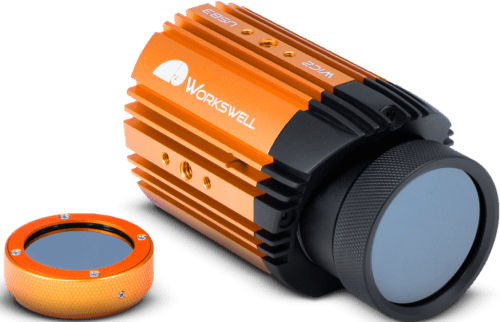
Modern thermal camera cores and OEM modules rely on carefully matched combinations of sensors and optics. The same applies to UAV and drone payloads, PTZ thermal cameras, and fixed industrial or security systems.
Choosing the Right LWIR Optics: Quick Checklist
-
Match focal length and FOV to your mission
- Check F-number vs. sensitivity requirements
- Consider coatings for your environment (UAV, maritime, outdoor)
- Make sure optics do not limit sensor resolution
FAQ
Germanium Lenses and LWIR Optics
Quick answers about why germanium optics matter for long-wave infrared (8–14 μm) thermal imaging.
What is a germanium lens used for in a thermal camera?
A germanium lens is used to focus LWIR infrared radiation onto the detector, allowing the thermal camera to form a sharp and accurate thermal image.
Why are germanium lenses better than glass for LWIR?
Standard optical glass is opaque in the LWIR range. Germanium efficiently transmits 8–14 μm radiation, which makes it suitable for thermal imaging optics.
Do germanium lenses affect thermal image resolution?
Yes. The optical quality of the lens directly affects image sharpness, contrast, and the effective resolution of the thermal imaging system.
Are germanium lenses coated?
Yes. Most LWIR germanium lenses use protective and anti-reflective coatings, such as DLC, to improve durability and optical performance.
Looking for More?
If you are looking for a thermal imaging solution that combines European quality, top-tier performance, and complete regulatory independence, the WEOM Thermal Core is here to deliver. Completely ITAR-free and designed for seamless integration, this module isn’t just a component—it’s a comprehensive solution. Whether you need integration support or expert advice, our team is ready to help.
Interested in learning more or exploring integration possibilities?
Get in touch with our team—our experts are ready to help you find the perfect configuration to meet your mission requirements.
